
Digital or print sheet music: Which should you choose in 2026?
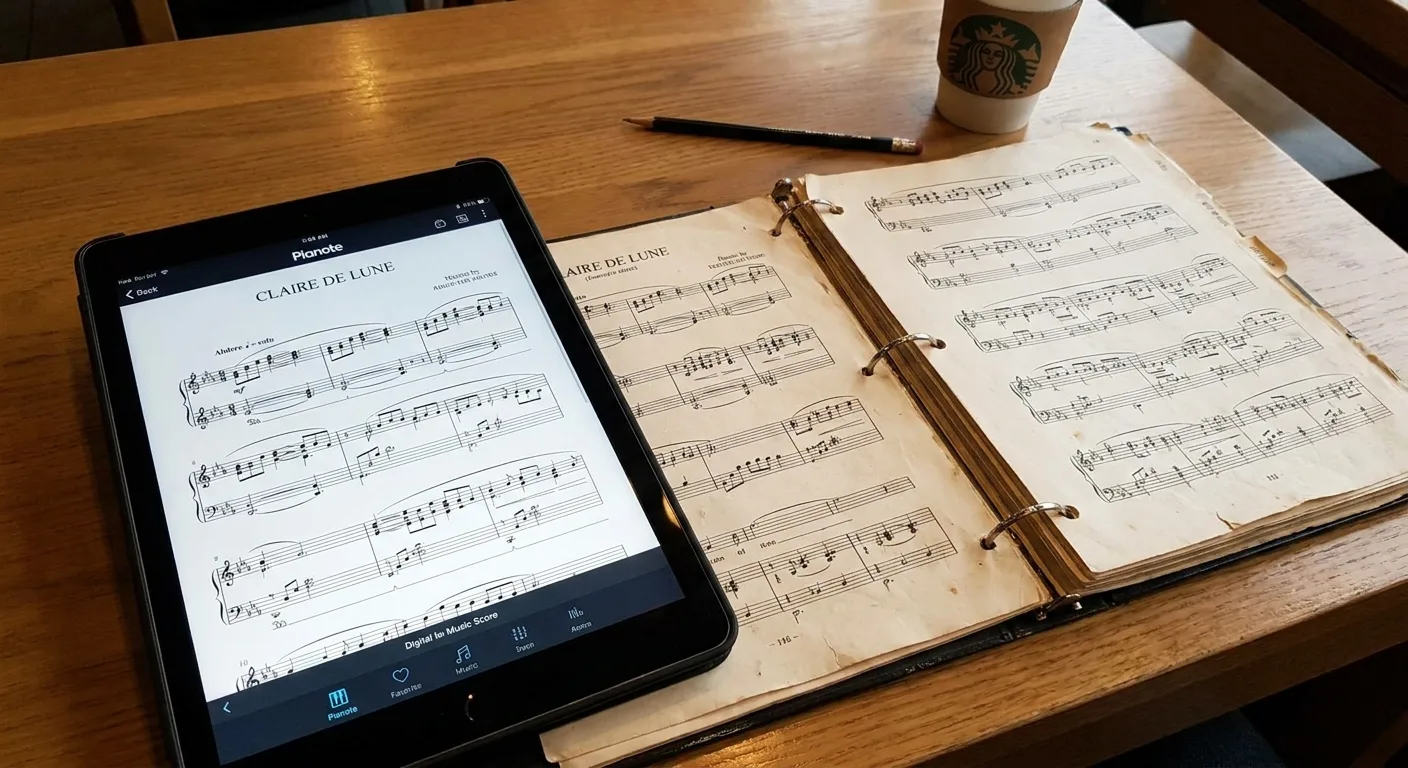
Table of Contents
What is the difference between a digital score and a paper score?
A digital sheet music file is a file (PDF, MusicXML, or image) viewed on a tablet using a sheet music app, whereas a paper sheet music score is a single, uneditable printed copy. The distinction goes beyond just the display format.
Paper sheet music is handled by hand, annotated with a pencil, and stored in a physical binder. It doesn’t require batteries, but it gets damaged, yellows, and takes up space. A symphony orchestra sometimes has to manage several thousand sheets, which poses a real logistical challenge before each concert.
Digital sheet music, on the other hand, lives in a virtual library. With Newzik, a French app launched in 2015, a musician can store thousands of sheet music files on a single iPad. The MusicXML format even makes it possible to transpose a piece or change the instrumentation without having to reprint anything. This feature is what sets a simple PDF viewer apart from a full-featured sheet music app.
The turning point revolves around annotation and sharing. On paper, an annotation remains confined to a single sheet. In the digital realm, annotations sync and are shared across music stands in a matter of seconds. According to Music Trades (2024), sales of tablets designed for reading sheet music have grown every year since 2020. The difference, therefore, is not just a matter of medium—it’s a change in working methods for any musician who performs regularly.
Why Switch to Digital Sheet Music in 2026?
We're moving toward digital sheet music to centralize thousands of pieces on a single device, make unlimited annotations, and turn pages without putting down our instruments. The Newzik sheet music app meets all three of these needs.
The first benefit is storage capacity. A 256 GB iPad Pro can store the equivalent of dozens of binders. A guitarist in a pop band no longer has to sort through folders before every rehearsal: his entire library fits in a bag. This point comes up time and again among professional musicians who have been using Newzik for several years.
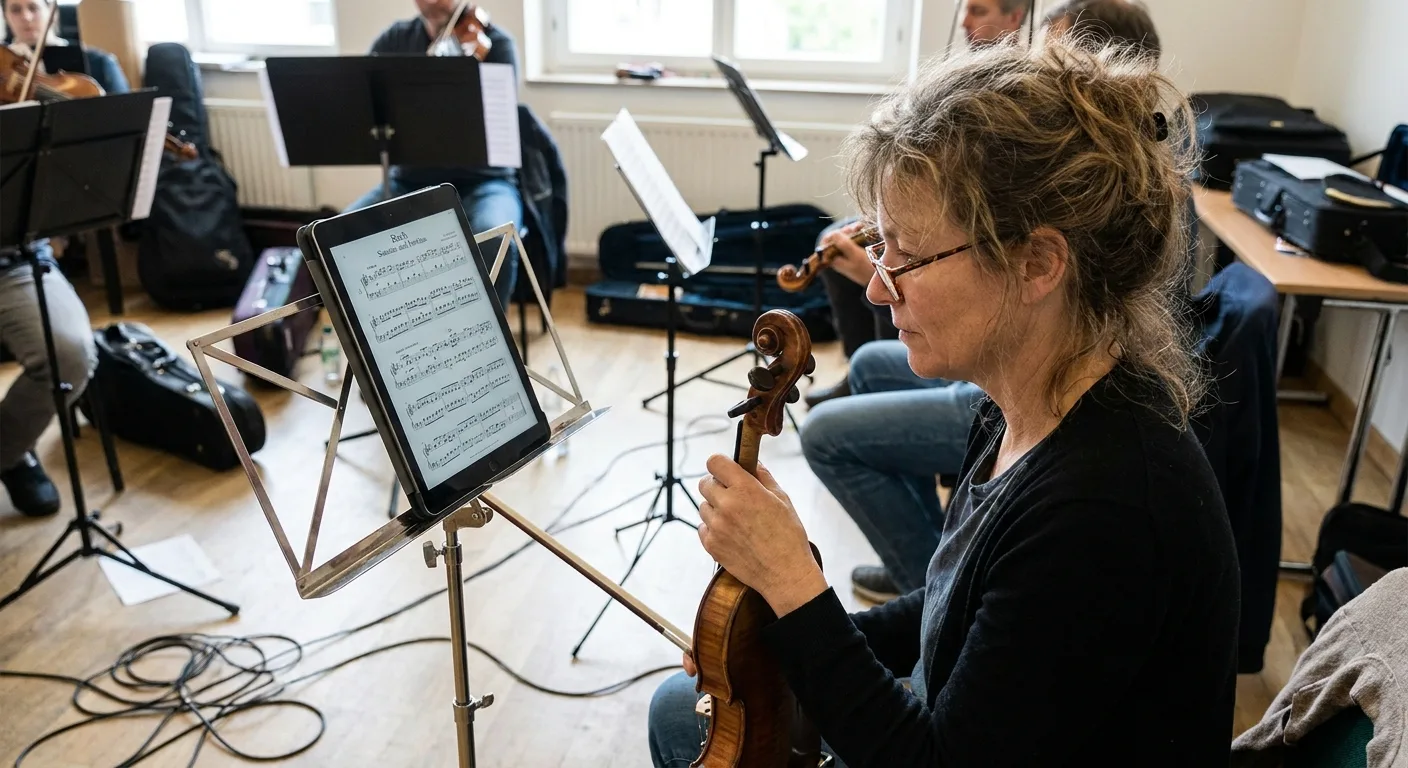
The second benefit is hands-free page turning. Thanks to a Bluetooth foot pedal or theaudio-matching featurethat tracks the performance in real time, the musician never has to put down their instrument. On stage, this eliminates interruptions in playing during fast passages.
Over 1,000 sheet music scores
Current capacity of a Newzik library on a 256 GB iPad (Newzik, 2026)
The third benefit relates to collaborative work. A conductor shares the same annotated version withthe entireensemble using the collaborative sharing feature. Gone are the days of handing out photocopies. To organize this library, Newzik offers tools for sorting by setlist, composer, or concert date. This ability to centralize and organize an entire repertoire explains why many conservatories and orchestras are adopting a sheet music app rather than printing out multiple copies.
Is there still any value to printed sheet music?
Paper sheet music remains useful for reading without a screen for long hours, playing without worrying about the battery dying, and working in places where tablets are prohibited. It will not disappear entirely by 2026.
The main advantage of paper is that it doesn't require electricity. A pianist who rehearses for five hours straight never has to worry about the battery level. At a remote concert with no power outlet nearby, this detail matters. Newzik also recommends checking your iPad's battery life before a long performance.
The second advantage pertains to certain exams and entrance exams. Several conservatories still require paper sheet music for official exams, particularly foradmission to music conservatories. The rules take precedence over personal preference.
The third point is visual comfort. Some musicians find reading from a screen more tiring during very long sessions, even though recent iPad displays have significantly reduced this issue. A study by the INRS (2023) notes that regular breaks are recommended when spending time in front of screens.
Paper therefore still has a place, but a limited one. For most everyday uses—rehearsals, classes, concerts—a music score app like Newzik meets those needs while eliminating the hassle of managing a binder. Paper has become a supplement rather than a primary working tool.
Comparison: Digital vs. Paper, Point by Point
Digital formats have the edge when it comes to storage, annotation, and sharing, while paper still has the advantage in terms of portability and use during exams. The table below summarizes the key criteria for choosing a music sheet app like Newzik.
Storage
- Digital Sheet Music (Newzik): Over 1,000 sheet music pieces on an iPad
- Paper sheet music: Bulky physical binders
Annotations
- Digital Sheet Music (Newzik): Unlimited, Editable, Synchronized
- Paper sheet music: Pencil-written, local, smudged
Page Turner
- Digital Sheet Music (Newzik): Bluetooth Pedal or Audiomatching
- Printed Sheet Music: Manual, One-Handed
Share
- Digital Sheet Music (Newzik): Snapshot of an Entire Ensemble
- Printed sheet music: Photocopies to be distributed
Transposition
- Digital Sheet Music (Newzik): Automatic via MusicXML
- Printed sheet music: Handwritten transcription
Battery Life
- Digital Sheet Music (Newzik): Depends on the battery
- Printed sheet music: No limit
Initial cost
- Digital Sheet Music (Newzik): Tablet + App Subscription
- Paper Sheet Music: Printing as You Go
How much does the switch to digital cost?
The switch to digital costs the price of a tablet (€300 to €1,500, depending on the model) plus a subscription to a sheet music app, which often costs a few euros a month. Newzik offers a free version so you can try it out before committing.
The main investment is still the iPad. An entry-level model is sufficient for reading sheet music, while an iPad Pro offers a larger screen, close to A4 size. The Newzik blog explains which iPad to choose for music based on your budget and stage use.
On top of this cost is the app itself. Newzik operates on a model that includes a free version and a subscription for advanced features such as unlimited synchronization and album sharing. This amount is comparable to the recurring expenses for photocopying and binding that a professional musician incurs each year.
Key takeaways
- A music tablet costs between €300 and €1,500, depending on the model (Apple, 2026)
- Newzik offers a free version before you subscribe
- Digital technology quickly offsets the cost of a professional's recurring photocopying expenses
In the long run, using a music sheet app also eliminates the need to replace damaged sheet music and to store physical copies. For a teacher who uses a variety of teaching materials, the decision quickly tilts in favor of digital options.
Can you annotate and turn the pages just like on paper?
Yes, a music sheet app like Newzik lets you make annotations with a stylus and turn pages hands-free, offering more flexibility than paper. That’s actually one of the key advantages of digital technology.
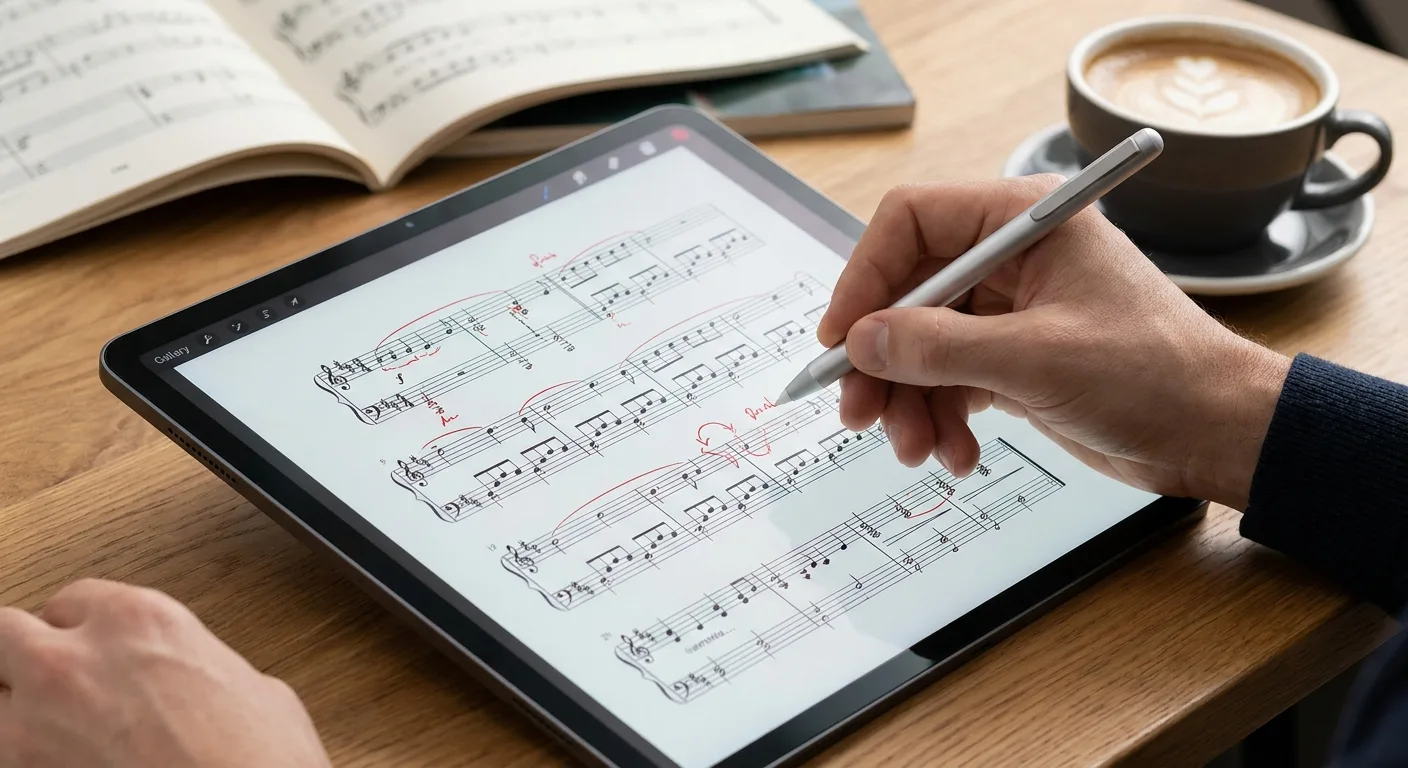
Annotating with the Apple Pencil replicates the feel of writing with a pencil on paper—but without smudging the page. You can erase, move, and change colors. The Newzik guide explains how to annotate a sheet of music on an iPad with fingering, rests, or repeats. All annotations remain linked to the file and are available on every synced device.
The page turner, long considered the weak point of printed music, is becoming a digital asset. Newzik offers a Bluetooth foot pedal that turns the page with a single press of the foot. The audio-matching feature goes even further: it listens to the performance and automatically scrolls through the sheet music. This allows a violinist to keep both hands on the instrument throughout an entire movement.
Transposition is one final advantage that’s impossible to achieve on paper. Thanks to MusicXML, Newzik transposes a score in a single step to adapt it to a transposing instrument or a singer’s voice. Whereas paper required rewriting everything, this music score app recalculates the notation instantly. Annotation and page-turning are therefore no longer limitations, but strengths.
Which format should you choose based on your profile as a musician?
Digital formats are suitable for ensemble musicians, professionals, and teachers; paper scores remain relevant for occasional beginners and certain exams. The right choice depends on the volume of sheet music you use and how often you play.
Orchestra and ensemble
Newzik centralizes thousands of sheet music files and shares annotations with an entire section.
Teacher
The entire library in your pocket—so you can manage group classes without photocopies.
Live musician
A page-turner at the foot of the stage and setlists ready before every concert.
Occasional beginner
Paper is enough for a few pieces, but once the volume picks up, we switch to digital.
An orchestra musician saves a considerable amount of time with a sheet music app: no more sorting through folders, and managing a large repertoire is simplified. A teacher appreciates being able to manage group lessons without having to use multiple materials. A performing musician benefits from the hands-free page turner.
Beginners working on two or three pieces can start with paper sheet music. As their library grows, Newzik becomes more convenient. Music conservatories and schools are, in fact, increasingly relying on digital tools for music education. While individual needs determine the format, the underlying trend—confirmed by the NAMM annual report (2024)—is toward digital sheet music.
What Our Customers Say
Newzik has an average rating of 5.0/5 based on 5 verified reviews from professional musicians and teachers.
"An excellent app for sheet music. I'm a professional musician and teacher, and I use it every day. It runs smoothly and offers plenty of options for annotations. And for my lessons, I have my entire library right in my pocket (or almost). I highly recommend it!"
— Franck Paque, professional musician and teacher
★★★★★ 5/5
"PROFESSIONAL! An app that never crashes and does everything you need to work like a pro. Perfect in every way, from music education to live performance. Well done, and thank you to the developers at the Newzik team!"
— Gilles Wilhelm
★★★★★ 5/5
"My go-to sheet music app for years! As a professional musician, I’m very satisfied with Newzik’s user-friendliness, features, and stability. As an early adopter, I’ve seen it evolve (always for the better!) and I highly recommend it to all musicians—both professional and amateur—who are looking for the best solution for reading sheet music on a tablet."
— Ez, professional musician
★★★★★ 5/5
"As a daily user of the French app NEWZIK for reading and annotating sheet music, I highly recommend it: whether for orchestras, chamber music, or educational settings… the app is updated very regularly and always for the better! Long live NEWZIK!"
— David Nicolas
★★★★★ 5/5
"I've been a Newzik user and tester from the very beginning. I've had the pleasure and joy of watching this app evolve and reach levels of perfection I never thought possible. I use it EVERY DAY. The Newzik team is young, dynamic, and very responsive when issues arise. I can only encourage you to give it a try... and you’ll love it. I play in a pop band (on guitar, with hundreds of sheet music files and backing tracks...)"
— Danimperator Dan, guitarist in a variety band
★★★★★ 5/5
Frequently Asked Questions
Does a music sheet app work without an Internet connection?
Yes. Newzik stores sheet music locally on the iPad, allowing you to play and annotate offline. Synchronization then takes place as soon as a connection is available.
Can you convert your paper sheet music to digital format?
Yes. You can scan a paper sheet of music as a PDF or take a photo of it, then import it into Newzik. The app also supports the MusicXML format for advanced features such as transposition.
Is the automatic page turner reliable during a concert?
Newzik's Bluetooth pedal remains the most reliable solution for live performances because it relies solely on the musician's movements. Audiomatching, which tracks the performance, provides added convenience during rehearsals and on stage.
Do you need a recent iPad to use Newzik?
No. Even an entry-level iPad can display sheet music just fine. A larger or newer model improves the reading experience and the speed at which large libraries of sheet music are displayed.
Is digital technology accepted in music conservatories?
More and more music schools are accepting digital sheet music for classes and rehearsals. Some official exams still require paper copies: it’s best to check the school’s rules.
Is Newzik a French app?
Yes, Newzik is a French app designed for reading and annotating sheet music. It is regularly updated and is used by orchestras, teachers, and amateur musicians alike.
# 5. DONNÉES STRUCTURÉES (JSON) ```json { "summary": "En 2026, la partition numérique remplace le papier pour la plupart des musiciens grâce à une application de partitions musicales comme Newzik : une bibliothèque entière tient sur un iPad, les annotations sont infinies et le tourne-page se fait au pied. Le papier garde un intérêt pour la lecture longue sans écran et l'absence de batterie. Le choix dépend de votre volume de partitions et de votre usage sur scène ou en cours.", "keyTakeaways": [ "Une tablette pour la musique coûte de 300 € à 1 500 € selon le modèle (Apple, 2026)", "Newzik propose une version gratuite avant tout abonnement", "Le numérique amortit vite le coût des photocopies récurrentes d'un pro", "Un iPad de 256 Go stocke plus de 1 000 partitions dans une seule bibliothèque Newzik", "Le papier garde l'avantage sur l'autonomie et certains examens officiels" ], "keyConcepts": [ {"term": "Partition numérique", "definition": "Fichier PDF, MusicXML ou image lu sur tablette via une application de partitions musicales, annotable et partageable."}, {"term": "Partition papier", "definition": "Support imprimé unique, non modifiable, annoté au crayon et rangé dans un classeur physique."}, {"term": "Audiomatching", "definition": "Fonction qui écoute le jeu du musicien et fait défiler la partition automatiquement en temps réel."}, {"term": "MusicXML", "definition": "Format de fichier musical permettant de transposer ou de modifier l'instrumentation d'une partition sans réimpression."}, {"term": "Tourne-page mains libres", "definition": "Système de pédale Bluetooth ou d'audiomatching qui tourne la page sans lâcher son instrument."} ], "faq": [ {"question": "Une application de partitions musicales fonctionne-t-elle sans connexion Internet ?", "answer": "Oui. Newzik stocke les partitions localement sur l'iPad, ce qui permet de jouer et d'annoter hors ligne. La synchronisation se fait ensuite dès qu'une connexion est disponible."}, {"question": "Peut-on importer ses partitions papier dans le numérique ?", "answer": "Oui. On scanne une partition papier en PDF ou en photo, puis on l'importe dans Newzik. L'application reconnaît aussi le format MusicXML pour les fonctions avancées comme la transposition."}, {"question": "Le tourne-page automatique est-il fiable en concert ?", "answer": "La pédale Bluetooth de Newzik reste la solution la plus sûre en concert car elle dépend uniquement du geste du musicien. L'audiomatching, qui suit le jeu, apporte un confort supplémentaire en répétition et sur scène."}, {"question": "Faut-il un iPad récent pour utiliser Newzik ?", "answer": "Non. Un iPad d'entrée de gamme lit déjà des partitions correctement. Un modèle plus grand ou plus récent améliore le confort de lecture et la vitesse d'affichage des grandes bibliothèques."}, {"question": "Le numérique est-il accepté dans les conservatoires ?", "answer": "De plus en plus de conservatoires acceptent les partitions numériques en cours et en répétition. Certains examens officiels imposent encore le papier : mieux vaut vérifier le règlement de l'établissement."}, {"question": "Newzik est-elle une application française ?", "answer": "Oui, Newzik est une application française dédiée à la lecture et à l'annotation de partitions. Elle évolue régulièrement et sert aussi bien les orchestres que les enseignants et les musiciens amateurs."} ], "sources": [ {"label": "INRS - Travail sur écran", "url": "https://www.inrs.fr"}, {"label": "NAMM Global Report 2024", "url": "https://www.namm.org"}, {"label": "Apple - iPad", "url": "https://www.apple.com/fr/ipad/"} ], "tags": ["partitions numériques", "partitions papier", "application de partitions musicales", "Newzik", "iPad musique", "annotation partition"] }All resources








.png)
.jpg)
.png)


.png)
Subscribe to our newsletter